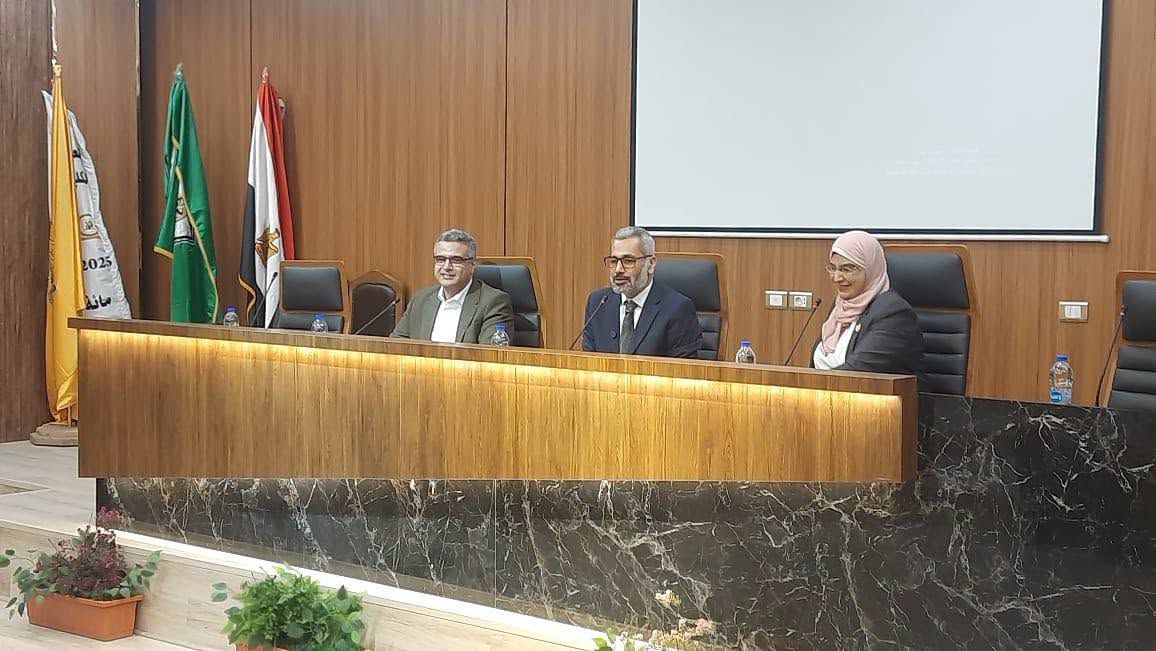
Under the generous patronage of Prof. Dr. Mohamed Sami Abdel Sadek, President of Cairo University, and the supervision of Prof. Dr. Mohamed Hussein Refaat, Vice President for Community Service and Environmental Development; Prof. Dr. Soheir Ramadan Fahmy, Dean of the Faculty of Science; and Prof. Dr. Ahmed Fouad, Vice Dean for Community Service and Environmental Development, and organized by Dr. Mahmoud Adel El-Hefnawy, Coordinator of the Athar Platform at the Faculty of Science, a seminar entitled “The Relationship Between Experimental Sciences and Islamic Sciences” was held as part of the Supreme Council for Islamic Affairs’ efforts, under the Ministry of Awqaf, to renew religious discourse.
The seminar featured Dr. Mohamed El-Mohamady, a faculty member at the Faculty of Islamic Da'wah, Al-Azhar University.
During the seminar, Dr. El-Mohamady addressed several important questions relevant to the Faculty of Science community, including: Do experimental sciences contradict religious faith? Is there a conflict between modern science and Islamic sciences? And can Islamic sciences be classified as sciences according to the modern definition of the term "Science"?
These thought-provoking topics encouraged active participation and meaningful discussions among faculty members and students. Dr. El-Mohamady also answered numerous questions raised by attendees, enriching the discussion and enhancing the seminar’s educational impact.
At the conclusion of the seminar, Dr. El-Mohamady presented a selection of religious books to students whose questions and contributions demonstrated a strong interest in the seminar's subject and a passion for exploring Islamic culture.
Additionally, a dedicated exhibition corner was established in the Old Botany Building to display selected religious publications issued by the Supreme Council for Islamic Affairs. The Council also donated a valuable collection of these publications to the Faculty.
The seminar highlighted the university’s role in community service by promoting enlightened thinking, supporting efforts to renew religious discourse within the university community, and strengthening communication between religious institutions and Cairo University.
It also emphasized the significant contributions of the Ministry of Awqaf and Al-Azhar Al-Sharif in promoting a sound understanding of Islam among young people and addressing misconceptions about Islamic teachings.
Furthermore, the seminar contributed to raising awareness of the potential harmony and integration between science and religion rather than viewing them as opposing fields. It also encouraged students to engage in reading and further exploration of Islamic culture.
The event was attended by approximately 50 students, in addition to several faculty members. It began at around 11:00 a.m. and lasted for more than two hours.